
Eagle & Anchor Rifle Maintenance Doctrine Manual - White Cover
8 sold in last 24 hours
Every clean flip depends on a platform you trust. While you hunt for the next butterfly knife for sale, this Eagle & Anchor Rifle Maintenance Doctrine Manual quietly handles the other side of your kit: keeping your 5.56 M16A2 running to USMC standards. Clear black‑and‑white diagrams, mil-spec procedures, and simple tabbed sections make this technical manual a fast reference in the shop, truck, or range bag. Flipper, collector, or daily carrier—readiness lives in your hands, too.
When the Flip is Clean and the Rifle Runs
The first time you land a truly clean chaplin or a perfectly timed behind-the-8, you feel it in your bones. Balance, timing, discipline—it’s the same mindset that keeps a service rifle running when the environment turns hostile. While you’re scrolling for the next butterfly knife for sale to level up your flipping, the rest of your kit still needs one thing: doctrine. That’s where the Eagle & Anchor Rifle Maintenance Doctrine Manual - White Cover earns its place.
This isn’t another hype piece. It’s a U.S. Marine Corps–style technical manual built for shooters, collectors, and prepared carriers who respect clear instruction as much as a smooth balisong action.
Not a Butterfly Knife for Sale, But the Same Discipline
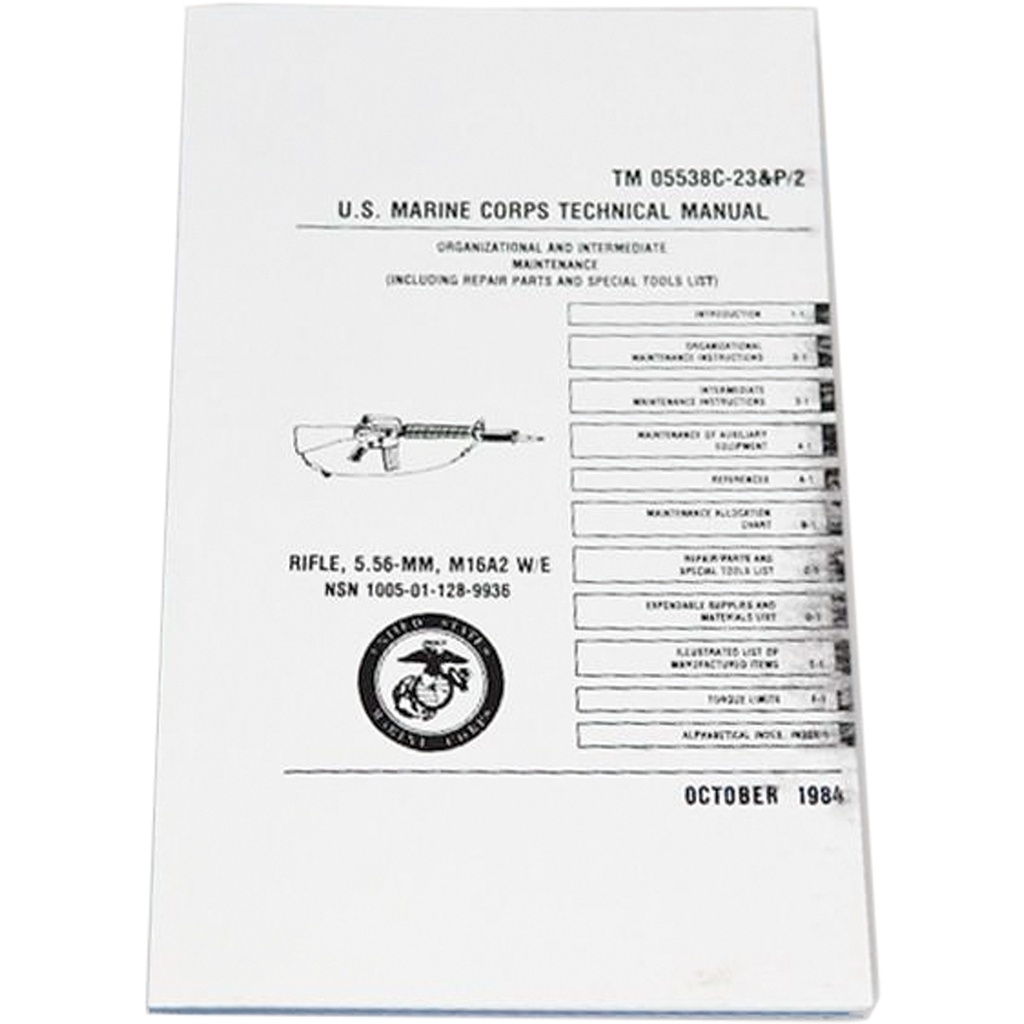
The balisong community understands repetition, mechanical feel, and respect for hardware. That same mentality runs through this technical manual. The cover mirrors an authentic USMC field document: black-on-white layout, an M16A2 line diagram, the Eagle, Globe, and Anchor, and tabbed sections printed down the side for fast indexing. It looks like it belongs in an armory or ruck, not on a coffee table.
Just like when you buy a butterfly knife, you’re not paying for flash—you’re buying control. Here, control means knowing how to maintain the 5.56mm M16A2 W/E to a standard that doesn’t blink when things go sideways.
Build Quality in Print: How This Manual is Put Together
Collectors obsess over washers vs. bushings, channel vs. sandwich handles, and pivot tolerances. The print equivalent is how information is structured so you can actually use it under pressure. This doctrine manual is built for that.
Perfect Bound, Field-Ready Pages
The manual uses a perfect bound softcover with a matte white finish. It rides flat enough on a bench for hands-on work but is compact enough to tuck into a range bag or glove box. The monochrome black-and-white interior keeps diagrams clear and readable in low light—no glossy glare, no clutter.
Tabbed Section Layout for Fast Reference
The right-hand tab print mimics a true mil-spec technical manual, breaking content into organizational and intermediate maintenance sections. Instead of hunting endlessly like a bad latch on a cheap balisong, you jump to what you need—disassembly, parts identification, troubleshooting—almost by muscle memory once you’ve used it a few times.
Diagram Clarity as Tight as a Good Pivot
Black line-art illustrations of the M16A2 match the no-nonsense style of USMC manuals from the October 1984 era. No overdone shading, just clean, high-contrast diagrams that act like visual exploded views. Think of it as having the same mechanical honesty you look for when you examine a balisong’s tang, tang pins, and handle alignment.
Why Balisong Collectors and Carriers Actually Care
If you’re searching for a balisong for sale, odds are you already live in a world where steel, hardware, and reliability matter. This manual plugs into that mindset. It’s for the person who maintains their collection, not just shows it off.
- For the flipper: The discipline you build dialing in combos is the same discipline behind proper rifle cleaning cycles, lubrication points, and inspection routines.
- For the collector: It sits on the shelf next to your higher-end butterfly knives as part of a broader kit—steel, tools, and reference.
- For the daily carrier: You care about readiness. This is readiness translated into USMC-style technical clarity.
The Eagle & Anchor Doctrine Manual doesn’t compete with your next butterfly knife for sale—it complements it. One handles the flips; the other backs your fundamentals.
Doctrine-Level Detail: What the Manual Covers
Modeled after U.S. Marine Corps publications (down to the manual code and NSN on the cover), this book focuses on organizational and intermediate maintenance for the 5.56mm M16A2 rifle. That means:
- Component identification and function—like knowing the bite handle from the safe handle on a balisong.
- Step-by-step disassembly and reassembly procedures that are as methodical as a trick breakdown.
- Cleaning, lubrication, and inspection checkpoints to prevent failures before they start.
- Troubleshooting sequences that mirror the way you track down play or tap in a worn pivot.
Everything is communicated in direct, field-usable language. No fluff, no filler, just the kind of stripped-down instruction Marines have used for decades.
What Balisong Buyers Want to Know
Are butterfly knives legal to buy?
Legality is the #1 question when someone searches for a butterfly knife for sale. Laws in the United States are state-specific and change over time, so always verify current statutes or talk to a qualified legal professional in your area before you buy or carry any balisong.
As a high-level, non-legal overview:
- Generally more permissive states (many in the South, Midwest, and parts of the West) either allow balisongs outright or treat them like standard folding knives, with some city or concealed carry restrictions.
- Restriction-heavy or ban-prone states (often in the Northeast and West Coast) may classify butterfly knives as gravity knives, switchblades, or prohibited weapons, limiting sale, possession, or carry.
- Local ordinances can be stricter than state law, especially in major cities.
This Eagle & Anchor manual is a book, so it ships cleanly where edged tools might not—but anytime you see a balisong for sale, check your state and local codes before purchasing or carrying.
What's the difference between a butterfly knife trainer and a live blade?
The balisong community draws a hard line here:
- Butterfly knife trainer: Has a dull, often unsharpened or cutout blade profile with no edge. It’s built strictly for flipping practice—learning openings, closings, and combos without cutting yourself. Same pivots, same handles, no edge.
- Live blade balisong: Fully sharpened cutting edge, actual point, and working steel. It’s a real knife that demands edge awareness during every flip. Mistiming a combo now has consequences.
Just like USMC doctrine separates training and live-fire procedures, the community respects starting on a trainer, then earning your way to a live blade once your control is dialed in.
Is this butterfly knife good for learning to flip?
This product is not a balisong or butterfly knife—it’s a technical manual. But the mindset it reinforces is the same mindset you want when you buy butterfly knife gear and start learning to flip: step-by-step progression, respect for hardware, and repeatable technique.
If you’re picking up your first butterfly knife for beginners, pair that trainer with this kind of doctrine-style approach. Follow structured steps, don’t skip fundamentals, and treat both your blades and your rifle with the same maintenance discipline. That’s how you build skill that actually lasts.
Collector, Flipper, Carrier: Where This Manual Fits
The Eagle & Anchor Rifle Maintenance Doctrine Manual - White Cover doesn’t care whether your main search today is “balisong for sale,” “butterfly knife flipping,” or “USMC technical manual.” It’s built for anyone whose identity lives where hardware, discipline, and readiness meet.
- The collector files it alongside their best pieces—custom balisongs, service rifles, and historical manuals.
- The flipper keeps it in the range bag, right next to trainers and live blades, as part of a complete kit.
- The daily carrier drops it in a glove box or go bag, because information is as critical as the tools themselves.
Whether you’re lining up the next butterfly knife for sale to sharpen your flipping game or revisiting the fundamentals that keep your rifle trustworthy, this manual backs the same core truth: skill, craft, and quality are earned, not claimed.